
Security Camera Placement Guide: Where Professionals Install Cameras for the Best Protection
Security Camera Placement Guide: Where Professionals Install Cameras for the Best Protection
One of the biggest mistakes homeowners make is assuming that buying high-quality security cameras automatically means they’ll have a secure property. In reality, security camera placement is often more important than the camera itself.
The Best Security Camera Isn’t Enough If It’s in the Wrong Location
One of the biggest mistakes homeowners make is assuming that buying high-quality security cameras automatically means they’ll have a secure property.
In reality, security camera placement is often more important than the camera itself.
A professionally installed 4K camera in the right location can capture faces, license plates, and important evidence with exceptional clarity. The exact same camera mounted a few feet too high, pointed in the wrong direction, or blocked by landscaping may miss the details that matter most.
After designing surveillance systems for homes and businesses throughout Florida, we’ve found that strategic placement consistently delivers better results than simply adding more cameras.
In this guide, we’ll walk through the locations professionals prioritize when designing an effective home surveillance system.
Start With Your Goals
Before mounting a single camera, ask yourself a simple question:
What am I trying to protect?
Your answer determines where cameras belong.
For most homeowners, the priorities are:
- Family safety
- Preventing package theft
- Monitoring vehicles
- Watching entry doors
- Protecting backyard access
- Recording suspicious activity
- Capturing usable evidence if an incident occurs
Instead of trying to see every square foot of your property, focus on the places where people are most likely to enter or spend time.
1. Front Door
If you can install only one camera, start here.
The front door is where deliveries arrive, visitors knock, contractors work, and unfortunately, many thefts begin.
A front-door camera should capture:
- Faces clearly
- Package deliveries
- Visitors approaching
- Door activity
- Anyone leaving with packages
Avoid pointing the camera directly toward the street, where backlighting from the sun or headlights can reduce image quality.
Instead, angle it slightly downward toward the approach.
2. Driveway
Your driveway often protects your second-largest investment after your home.
A driveway camera should monitor:
- Parked vehicles
- People approaching cars
- Mailbox activity
- Vehicle arrivals
- License plates when possible
Whenever practical, avoid mounting cameras excessively high. A lower mounting height often produces better facial detail.
3. Garage
Garages frequently contain:
- Expensive tools
- Bicycles
- Lawn equipment
- Power equipment
- Storage
- Access into the home
Cover both:
- The garage door
- Any side access doors
If your garage has interior access to your home, that doorway deserves attention as well.
4. Backyard
Many homeowners focus entirely on the front of the property while leaving the backyard largely unprotected.
Backyards often contain:
- Pools
- Patio furniture
- Outdoor kitchens
- Children’s play areas
- Storage sheds
- Pets
A well-positioned backyard camera should provide a wide view while minimizing blind spots created by fences or landscaping.
5. Side Gates
Side yards are among the most overlooked areas during DIY installations.
They’re also common access points because they offer privacy from the street.
A camera watching each side gate provides valuable coverage of anyone attempting to access the backyard unnoticed.
6. Backyard Shed or Workshop
Storage buildings frequently hold:
- Lawn equipment
- Generators
- Construction tools
- ATVs
- Motorcycles
- Seasonal decorations
Rather than placing one camera inside the shed, professionals often recommend monitoring the approaches to the structure as well.
Capturing someone before they force entry is often more valuable than recording them after they’re already inside.
Don’t Mount Cameras Too High
This is probably the most common installation mistake we see.
Many homeowners believe higher equals better.
Unfortunately, the opposite is often true.
A camera mounted 20 feet above the ground may capture the tops of hats instead of faces.
Professional installations typically aim for mounting heights that balance:
- Facial recognition
- Wide coverage
- Protection from vandalism
- Ease of maintenance
Higher isn’t always smarter.
Think About Lighting
Lighting dramatically affects image quality.
Whenever possible:
✅ Avoid pointing directly toward the sunrise or sunset.
✅ Avoid bright floodlights shining directly into the lens.
✅ Position cameras so nighttime lighting works with the camera—not against it.
Even advanced color night vision cameras produce better results when the scene has consistent lighting.
Eliminate Blind Spots
Instead of asking:
“Can this camera see everything?”
Ask:
“Where would someone disappear?”
Walk around your property.
Stand behind bushes.
Stand beside fences.
Walk under trees.
Look for places where someone could approach unseen.
Those areas often deserve camera coverage more than large open spaces.
Don’t Forget the Internet Connection
For PoE security cameras, cable routing matters just as much as camera placement.
Planning cable paths before installation can:
- Reduce labor
- Protect wiring
- Simplify future upgrades
- Improve overall system reliability
A clean installation today often saves hours of work later.
Common Home Camera Layouts
Four-Camera System
Ideal for:
- Front Door
- Driveway
- Backyard
- Garage
Eight-Camera System
Adds:
- Side Gates
- Patio
- Backyard Shed
- Additional Front View
Sixteen-Camera System
Provides complete perimeter coverage plus:
- Interior entry points
- Pool area
- Detached structures
- Multiple vehicle angles
- Side yard overlap
- Larger backyards
The right number of cameras depends on the size of the property, the number of access points, and the level of detail you want to capture.
Our Professional Approach
When we design a surveillance system, we don’t simply count corners of a building and install cameras.
We ask questions like:
- Where would someone approach without being seen?
- Where are your most valuable assets?
- Which entrances are actually used every day?
- Where will lighting create challenges?
- What evidence would you need after an incident?
Every property is different, and camera placement should reflect the way the property is actually used—not just what looks symmetrical.
Recommended Equipment
For most homes, we recommend:
- 4K (8MP) PoE IP Cameras
- Turret-style cameras for better low-light performance and reduced glare
- Built-in audio where permitted by law
- Color night vision
- Network Video Recorder (NVR)
- 24/7 continuous recording
- Remote smartphone viewing
These features provide reliable, long-term protection while delivering the image quality needed to identify people, vehicles, and important details.
👉 Explore our professional home security camera systems designed for complete perimeter protection and dependable 24/7 surveillance.
Recommended products
-
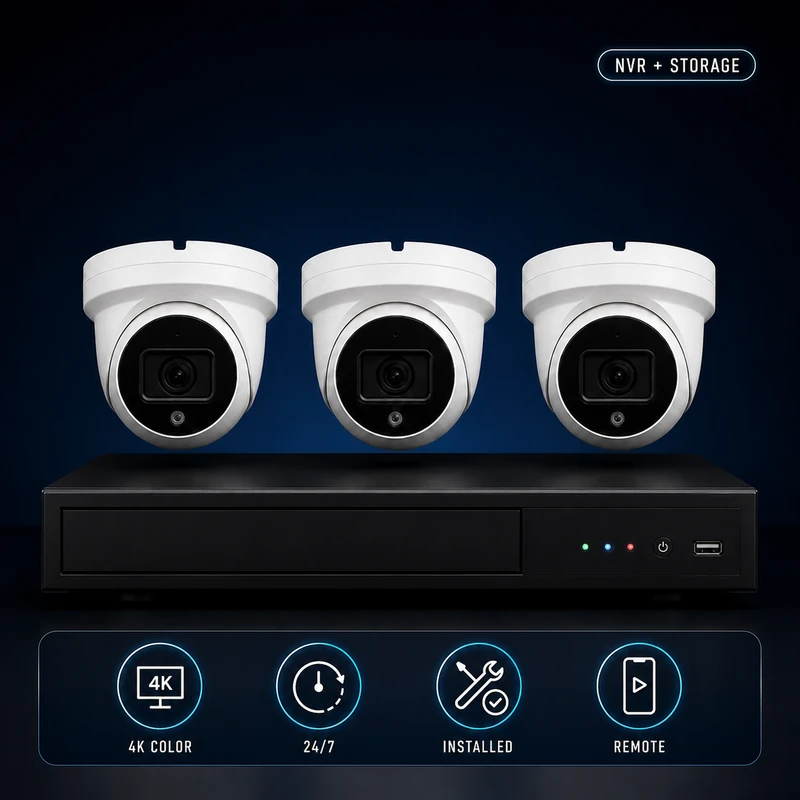
(3) 4k Camera Security System Bundle – Complete Installation & Remote Viewing Setup
$1,450.00$1,737.95 -
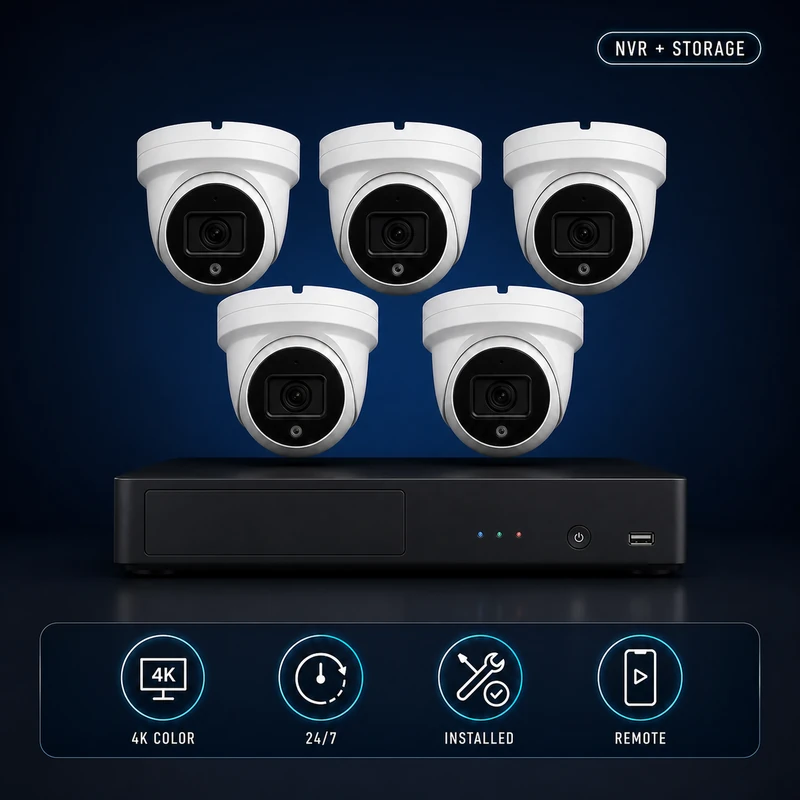
(5) 4k Security Cameras + PRO Installation Bundle
$1,900.00$2,426.93 -
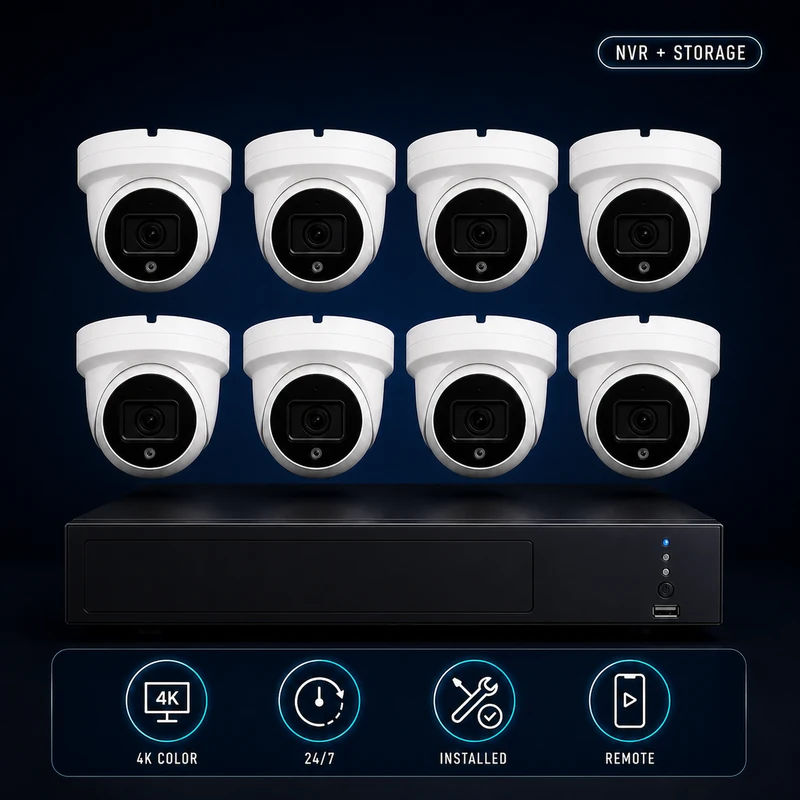
(8) 4k Security Cameras + PRO Installation Bundle
$2,712.00$3,527.90 -
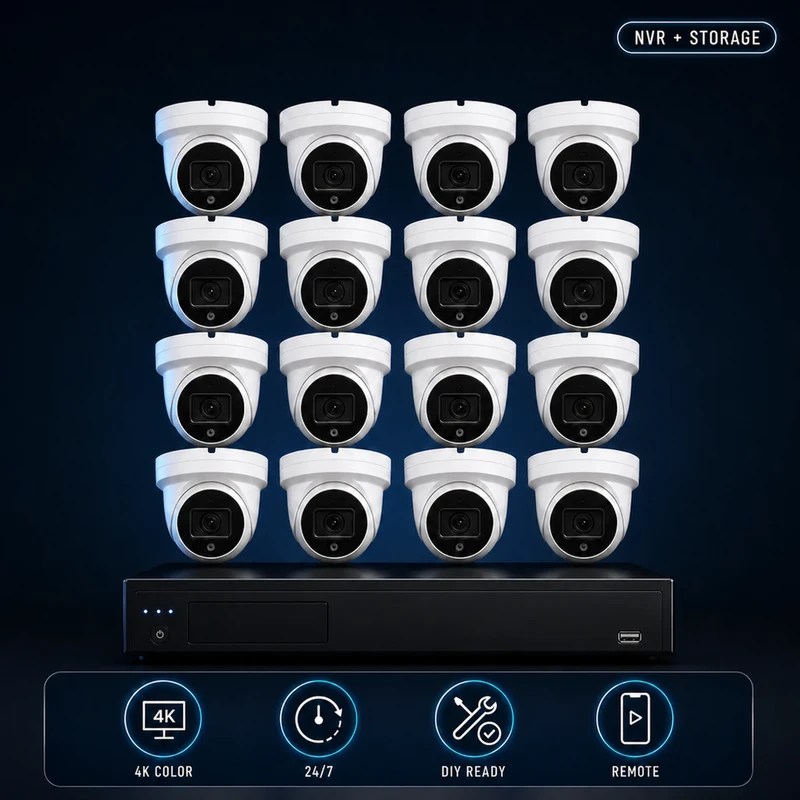
SecureView Standard™ 16 Camera Security System
$3,341.00$5,809.67
Frequently Asked Questions
Should security cameras point at the street?
It’s usually better to prioritize your own property while still capturing approaches and entrances. A slight angle often provides more useful evidence than pointing straight into traffic.
How high should outdoor security cameras be installed?
Mount cameras high enough to discourage tampering but low enough to capture recognizable facial details. Excessive height often reduces identification quality.
Is one camera enough?
A single camera can help monitor a key area, but most homes benefit from multiple cameras covering primary entrances, driveways, and outdoor living spaces.
Should cameras overlap?
Yes. Overlapping fields of view reduce blind spots and can capture multiple angles of the same event, improving both coverage and evidence quality.
Final Thoughts
The effectiveness of a surveillance system depends on more than the cameras you buy—it depends on where those cameras are installed. Thoughtful placement helps eliminate blind spots, improves identification, and ensures you’re recording the moments that matter most. By focusing on entrances, driveways, garages, side gates, and outdoor living areas, homeowners can build a security system that provides meaningful protection rather than just broad coverage.