
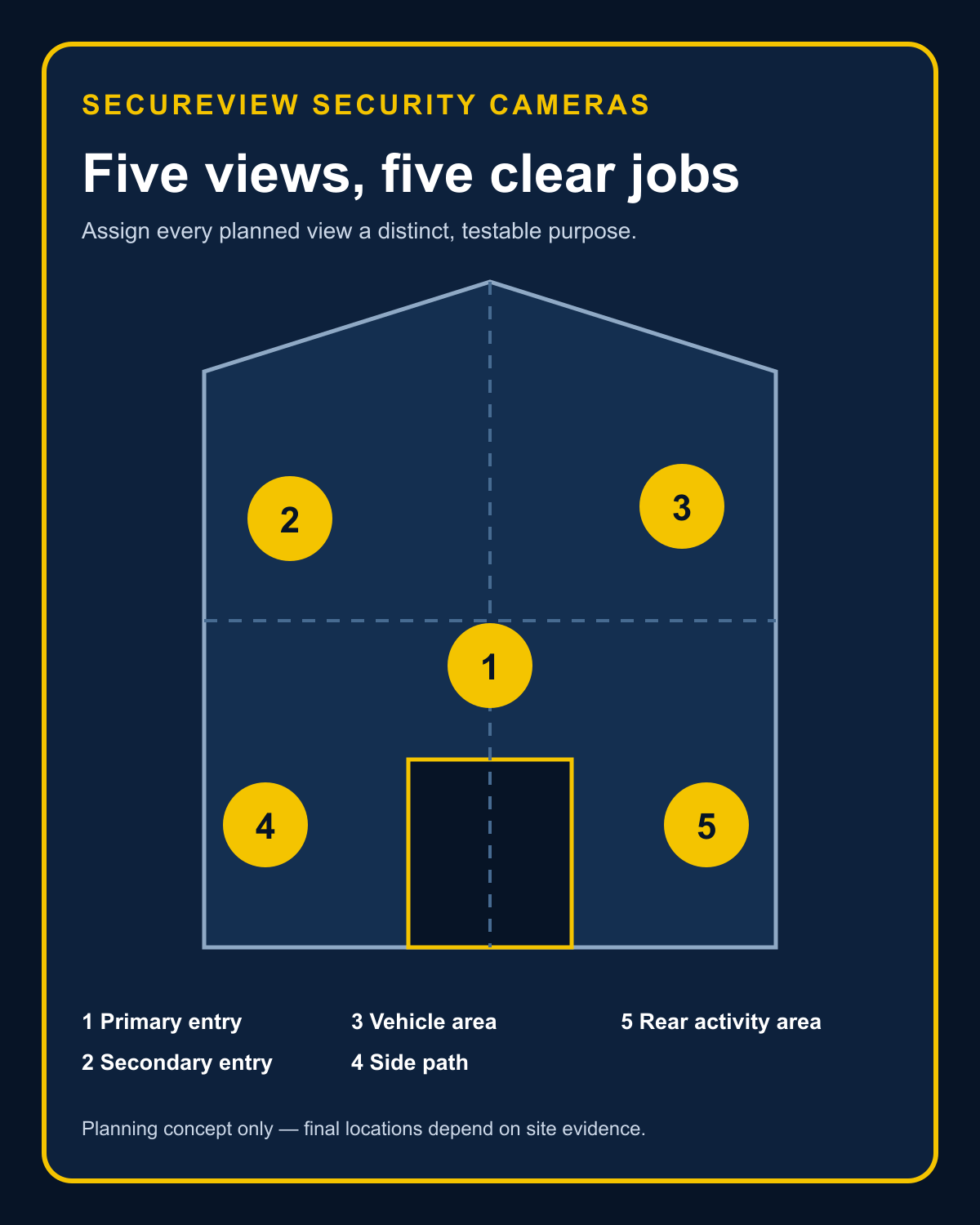
Five cameras are most useful when each view has a different job. Start with the three events that matter most—such as a primary entry, a secondary entry, and vehicle activity—then use the remaining two views to address the most important gaps. The goal is not to place cameras evenly. It is to collect useful views of the events you want to understand.
Start with five questions
- Where would a person most likely approach or enter?
- Which second route would otherwise go unobserved?
- Where do vehicles, deliveries, or other recurring activity occur?
- Which side path or transition area connects the front and rear?
- What rear or secondary activity area matters enough to justify its own view?
Write one sentence for each view before choosing a mounting point. “See the front” is too broad. “Show a person approaching the primary door without the porch column blocking the path” is testable. If two planned views have the same sentence, one may be better used on an uncovered route.
Add views for gaps, not symmetry
After the first three priorities, walk the likely routes around the property. Look for fences, vegetation, parked vehicles, deep overhangs, backlighting, and turns that can hide movement. The CISA personal-security guide discusses attention to surroundings, exterior lighting, and blind spots; use that source as general planning context, not as a guarantee that a particular camera placement will work.
Keep an overview goal separate from an identification goal. One wide view may explain where activity occurred, while a more focused view may be needed for a doorway or other decision point. Do not assume that adding cameras automatically improves useful detail.
Choose a matching path only after the plan
If you want SecureView to evaluate a 5-camera installed-bundle path, installation remains dependent on location and scope. If you are planning your own installation, use the separate SecureView Standard 5 DIY record. These are different product paths; this guide does not combine their contents or terms.
Installed bundle: View the exact 5-camera installed-bundle record
SecureView Standard DIY: View the exact 5-camera Standard DIY record
Before choosing either path, compare this plan with the 3-camera planning guide if you have only three critical jobs, or continue to the proposed 8-camera guide if the property needs zone-level planning. Review the existing camera placement guide for placement questions.
A camera count is a planning starting point, not a guarantee of complete coverage. Final locations depend on the property, viewing goals, lighting, obstructions, network and power constraints, privacy, and applicable rules.